- Primay purpose of impedance audiometry is
- To determine the quantum of sensorineural deafness
- To determine the status of ear drum and middle ear
- To determine the status of inner ear
- To determine the status of vestibular apparatus
- Features of impedance audiometry include
- Determines the status of ear drum and middle ear
- Secondary purpose of this investigation is to evaluate the acoustic reflex pathway
- Results of this test should always be interpreted in conjunction with pure tone audiometry
- This test clearly estimates the amount of sensorineural hearing loss
- Impedance audiometry can be affected by
- Mass, mobility and resistance systems of external and middle ear cavities
- Inner ear pathology
- Trigeminal nerve integrity
- Integrity of semicircular canals
- Tests included under impedance audiometry are
- Tympanometry
- Acoustic reflex threshold
- Acoustic reflex decay
- Eustachean tube function
- Probe tone used in impedance audiometry is
- 500 Hz
- 1000 Hz
- 226 Hz
- 5000 Hz
- While performing this test the pressure of external canal is varied between
- +200 to -400 decapascals
- + 50 to + 100 decapascals
- 100 pascals to 400 pascals
- +500 to +1000 decapascals
- Once of the common errors while performing impedance audiometry is
- Not using the proper stimulus frequency
- Unable to obtain perfect airtight seal is obtained
- Inability of patient to respond correctly whether the sound is heard or not
- Inner ear pathologies
- Impedance audiometry should not be performed in infants below the age of 7 months is
- The infant may not be able to indicate whether the sound is heard or not
- The suppleness of the cartilage of external canal may produce misleading results
- The external canal is too narrow in an infant
- Air tight seal cannot be obtained in an infant below the age of 7 months
- Classification of various tympanometric curves was introduced by
- Samuels
- Manning
- Jerger
- Jardorfer
- Impedance audiometry is useful in identifying
- Middle ear effusion
- Otosclerosis
- Glue ear
- Ossicular disruption
- Maximum compliance occurs
- When pressures in the external canal and middle ear are equal
- When pressure in the external canal is lesser than that of middle ear
- When the pressure in the middle ear is less than that of external ear
- When the middle ear pressure is negative
- Type A tympanogram curve indicates
- Normal middle ear function
- Secretory otitis media
- Adhesive otitis media
- Otosclerosis
- Features of Type A tympanogram are
- Indicates normal middle ear function
- Compliance peak occur between -150 and + 100 dpa
- Compliance peak occurs between -50 and -100 dpa
- Compliance value is between 0.2 - 2.5 millimhos
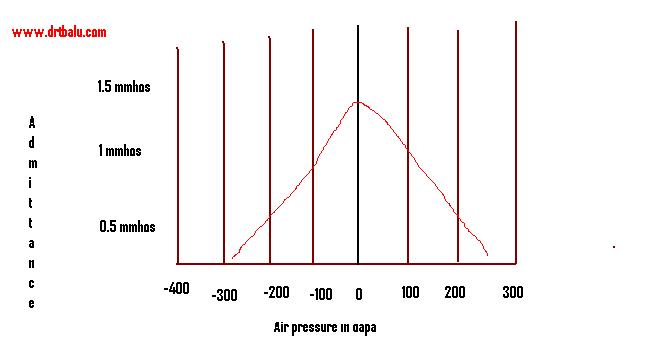
What is the type of impedance curve shown herre- Type A
- Type As
- Type B
- Type Ad
- As type curve indicates
- Normal middle ear
- Glue ear
- Normal inner ear function
- Normal labyrinthine function
- Features of Type As curve include
- Shallow curve
- Indicates compliant middle ear
- Indicates stiffened middle ear
- Compliance peak occurs at -150 to 100 dapa
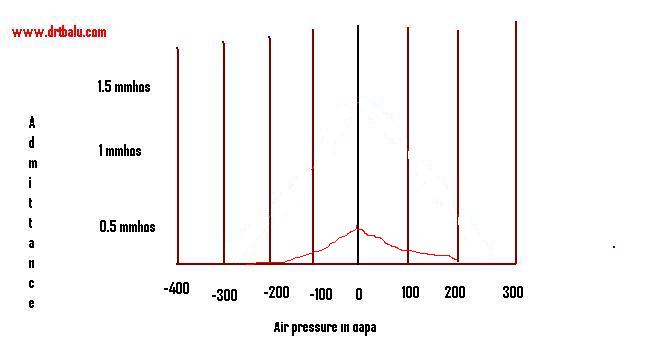
Name this impedance curve- Type A curve
- Type B curve
- Type Ad curve
- Type As curve
- Type Ad impedance curve suggests
- Normal middle ear fucntion
- High compliance middle ear
- Low compliance middle ear
- Normal inner ear function
- Features of Type Ad curve are
- Suggests flaccid ear drum / middle ear system
- Ossicular chain disruption
- Recording never goes off the chart
- Record goes off the chart
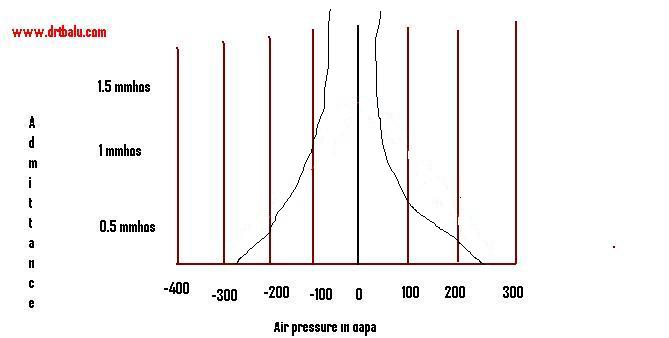
Name the type of impedance curve shown here- Type A curve
- Type B curve
- Type As curve
- Type Ad curve
- Type Ad curve is seen in
- Ossicular chain disruption
- Secretory otitis media
- Adhesive otitis media
- otosclerosis
- Type B curve
- Has an open peak
- Has no compliance peak
- Has a negative peak
- Indicates compliant ear drum
- Type B curve with normal canal volume suggests
- Otosclerosis
- Cerumen
- Otitis media
- Adhesive otitis media
- Average ear canal volume in adults is
- 3 ml
- 0.63 - 1.46 ml
- 10 ml
- 20 ml
- Average ear canal volume in a child is
- 0.42 - 0.97 ml
- 2 ml
- 4 ml
- 5 ml
- Type B curve with large canal volume is a feature of
- Cerumen
- Otitis media
- Perforated ear drum
- Secretory otitis media
- Type B curve with a small canal volume indicates
- Cerumen
- Otitis media
- Ear drum perforation
- Adhesive otitis media
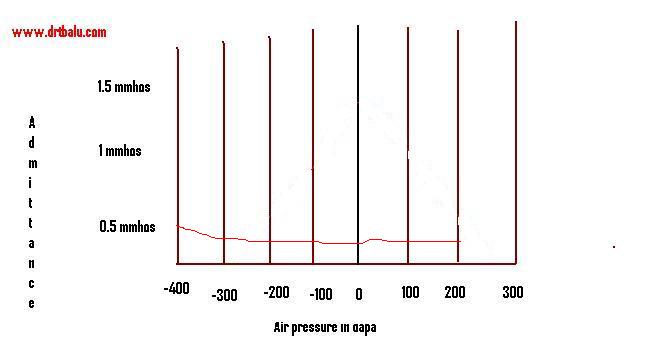
Name the type of cure shown above- Type A
- Type As
- Type c
- Type B
- Features of Type C curve indicates
- Significant negative middle ear pressure
- Eustachean tube dysfunction
- Peak occurs at - 150 dapa
- Presence of cerumen can cause this curve
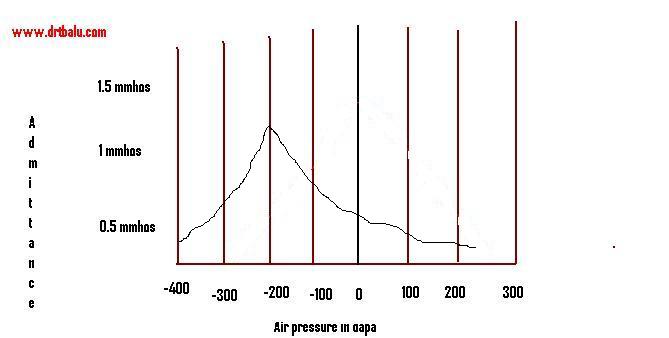
Name the type of curve shown above- Type A
- Type C
- Type B
- Type As